
Annual Surveys


Faculty in Higher Education Survey Methodology, 2025-26
CUPA-HR has been collecting data on higher ed faculty since the 1981-82 academic year. The data collection period for CUPA-HR’s Faculty in Higher Education Survey ran from November 3, 2025, to January 15, 2026. The survey was conducted through Surveys Online.[1]
Instructional Programs Surveyed
The instructional programs surveyed are based on the 2020 Integrated Postsecondary Education Data System (IPEDS) Classification of Instructional Programs (CIP).[2] The CIP taxonomy is a hierarchy organized on three levels:
- 2-digit codes (XX) define the most general groupings of related disciplines.
- 4-digit codes (XX.XX) define subdisciplines that have comparable content and objectives.
- 6-digit codes (XX.XXXX) define specific specialties within disciplines.
For example:
42) PSYCHOLOGY. Instructional programs that focus on the scientific study of the behavior of individuals, independently or collectively, and the physical and environmental bases of mental, emotional, and neurological activity.
42.27) Research and Experimental Psychology. Instructional content for this group of programs is defined in codes 42.2701-42.2799.
42.2701) Cognitive Psychology and Psycholinguistics. A program that focuses on the scientific study of the mechanisms and processes of learning and thinking, and associated information encoding, decoding, processing and transmitting systems. Includes instruction in theories of cognition and intelligence; studies of cognitive processes such as memory, sensation, perception, pattern recognition, problem solving, and conceptual thinking; cybernetics; psycholinguistics; and the study of biological and social communications mechanisms and processes.
Data Collected
Full-Time Faculty and Department Heads
This year’s survey includes data for 280,128 full-time faculty, including 171,283 tenure-track (TT) faculty; 100,429 non-tenure teaching (NTT) faculty; and 8,416 non-tenure research (NTR) faculty. Among full-time faculty reported, 8,754 were identified as department heads. This year’s survey also collected data for 54,538 adjunct (AD) faculty. For each type of faculty member, the following data were collected:
All Faculty
- Tenure type (TT, NTT, NTR, or AD)
- Highest degree attained [doctorate (Ph.D., M.D., J.D., or equivalent), master’s, bachelor’s, associate’s]
- H-1B status
- State of residence
- Sex (optional)
- Race/ethnicity (optional)
- Birth year (optional)
Tenure-Track Faculty Only
- Annualized 9-10-month salary (effective date November 1, 2025)
- Rank (professor, associate professor, assistant professor, and new assistant professor)
- Year entered current rank (required)
- Whether the faculty member is a department head (if checked, additional data on salary supplements, summer salary, and course relief were collected)
Non-Tenure-Track Faculty Only
- Annualized 9-10-month salary (effective date November 1, 2025)
- Year entered current position
- Whether the faculty member is a department head (if checked, additional data on salary supplements, summer salary, and course relief were collected)
- Non-Tenure-Track Research Faculty Only
- Annualized 9-10-month salary (effective date November 1, 2025)
- Year entered current position (required)
- Whether the faculty member is a department head (if checked, additional data on salary supplements, summer salary, and course relief were collected)
Adjunct Faculty Only
- Pay per credit hour
- Number of credit hours (not number of courses) being taught on November 1, 2025.
Participants uploaded a file containing this data.
Institutional Basics
In addition data on institutional characteristics were collected from all participants:
- Total expenses reported to IPEDS in 2024-25
- Student enrollment (effective date approximately October 15, 2025)
- Faculty size (effective date November 1, 2025) and number of separations in the past year
- Staff size (effective date November 1, 2025) and number of separations in the past year
- Human resources staff size and number of separations in the past year
- CHRO reporting relationship
- Whether collective bargaining exists for the following groups:
- Full-time faculty
- Part-time or adjunct faculty
- Full-time staff
- Graduate students
Basic information on total expenses as well as student, faculty, and staff size were required questions. All other questions were optional.
Respondents
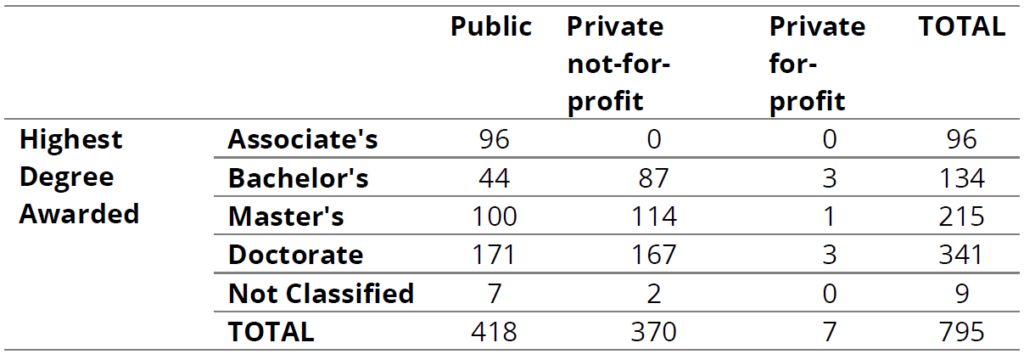
Respondents were largely human resources and provost office professionals from higher education institutions in the U.S. There were 795 institutions that completed the survey.
Citation Information
CUPA-HR. (2026). Faculty in Higher Education Survey, 2025-26 [Data set].
1 Surveys Online is a product of Peerfocus.
2 See the Faculty Survey Participation and Information Template for a complete list of all instructional programs surveyed, instructions to participants, and more information on how data were collected.
IPEDS 2020 Classification of Instructional Programs (CIP) Codes (2019). National Center for Education Statistics.