
Annual Surveys


Administrators in Higher Education Survey Methodology, 2025-26
CUPA-HR has been collecting data on higher ed administrators since 1967. The data collection period for CUPA-HR’s Administrators in Higher Education Survey ran from November 3, 2025, to January 15, 2026. The survey was conducted through Surveys Online.[1]
Positions Surveyed
The survey collected data on 205 positions grouped into six administrative categories:[2]
Top Executive Officers
These positions include Chief Executive Officer (Campus or System), Executive Vice President/Vice Chancellor, and Chief Academic Affairs Officer/Provost.
Senior Institutional and Chief Functional Officers
Persons in these positions direct a major functional area with institution-wide scope/impact as well as the work of other administrative and professional employees. They typically report to a top executive officer or other senior institutional officer. Examples include Chief Financial Officer, Chief Development/Advancement Officer, Chief Human Resources Officer, and Chief Information/IT Officer.
Institutional Administrators
Persons in these positions direct a functional area with institution-wide scope as well as the work of other professional employees. They serve as the senior content expert in a recognized professional realm. Examples include Chief Purchasing Officer, Chief Diversity Officer, Chief Hospital Administrator, and Chief Student Registration/Records Officer.
Heads of Divisions, Departments, and Centers
Persons in these positions manage an institutionally recognized division, department, or center and the work of other professional employees. Examples include Bursar, Chief Campus Bookstore Administrator, Chief Campus Benefits Administrator, and Chief Campus Student Housing Administrator.
Academic Deans
These are typically persons with faculty status who serve as the principal administrator/head of an academic program, which may be a school, college, or department.
Academic Associate/Assistant Deans
These are persons with or without faculty status who report to and support the dean in the administration of an institutional program, which may be a school, college, or department.
Data Collected
This year’s survey includes data for 50,338 administrators. For each administrator reported, the following data were collected:
- Annualized base salary (effective date November 1, 2025)
- H-1B status
- Sex (optional)
- Race/ethnicity (optional)
- Year entered current position (required)
- Birth year (optional)
- Whether the administrator has faculty status (for associate/assistant dean positions only)
- State of residence
In 2024-25, the survey included an optional total compensation section for Top Executive Officers, Senior Institutional and Chief Functional Officers, Academic Deans, and Institutional Administrators. This year, 213 institutions contributed total compensation data for 4,655 administrators. For each administrator, the following data were collected:
- To whom the administrator reports
- Whether administrator was paid a performance-based bonus or incentive
- If paid a performance-based bonus or incentive, the amount paid between 11/1/2024 and 10/31/2025
- Total amount of employer retirement contributions between 11/1/2024 and 10/31/2025
- Whether institutions contributed to a supplemental retirement program, including deferred compensation/457(b)
- If paid toward a supplemental retirement program, the amount paid between 11/1/2024 and 10/31/2025
- For presidents: Whether institution provides a residence (optional)
- For presidents: Whether institution provides housing allowance for rent/mortgage/upkeep/maintenance (optional)
- Institution-provided vehicle (full, partial, or no subsidy; optional)
- Institution-provided club membership (full, partial, or no subsidy; optional)
- For presidents and provosts, place of employment prior to current appointment (optional)
- For presidents and provosts, position prior to current appointment (optional)
Participants uploaded a file containing this data.
Institutional Basics
Basic data on institutional characteristics were collected from all participants:
- Total expenses reported to IPEDS in 2024-25
- Student enrollment (effective date approximately October 15, 2025)
- Faculty size (effective date November 1, 2025) and number of separations in the past year
- Staff size (effective date November 1, 2025) and number of separations in the past year
- Human resources staff size and number of separations in the past year
- CHRO reporting relationship
- Whether collective bargaining exists for the following groups:
- Full-time faculty
- Part-time or adjunct faculty
- Full-time staff
- Graduate students
Basic information on total expenses as well as student, faculty, and staff size were required questions. All other questions were optional.
Respondents
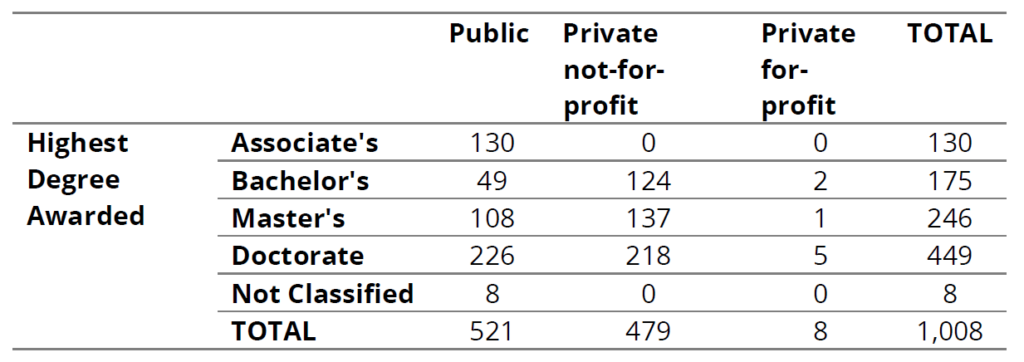
Respondents were largely human resources professionals from higher education institutions in the U.S. There were 1,008 institutions that completed the survey.
Citation Information
CUPA-HR. (2026). Administrators in Higher Education Survey, 2025-26 [Data set].
1 Surveys Online is a product of Peerfocus.
2 See the Administrators Survey Participation and Information Template for a complete list of all administrator positions surveyed, instructions to participants, and more information on how data were collected.